
Buying Strontiumnitrat responsibly requires more than comparing prices. Reliable sourcing begins with clear specifications, verified documentation, and a supplier that can explain every quality claim. This matters because strontium nitrate is an oxidizing chemical requiring careful storage, transport, and professional handling.
Quality-management expert W. Edwards Deming offered a useful principle: “In God we trust; all others must bring data.” For Strontiumnitrat procurement, that data may include a current certificate of analysis, safety data sheet, batch number, purity range, packaging details, and traceable manufacturing information. A supplier should answer practical questions without hesitation. Can they confirm the production site? Do test results match the delivered batch? Are storage instructions clearly provided?
Small details reveal a great deal. Check whether the label is readable, the container is sealed, and the documentation uses consistent product names. Confirm that the supplier follows applicable chemical-safety and trade requirements in your region. Do not rely only on marketplace ratings or attractive photographs. A polished website is not proof.
Even experienced buyers can overlook one missing document. That deserves reflection. A dependable supplier welcomes reasonable verification instead of pressuring customers to order quickly. They also communicate professionally when specifications change or a shipment is delayed. This guide explains how to assess Strontiumnitrat suppliers through transparent evidence, responsible purchasing practices, and realistic quality checks. The goal is not merely to find a seller, but to build a safer and more accountable supply relationship.
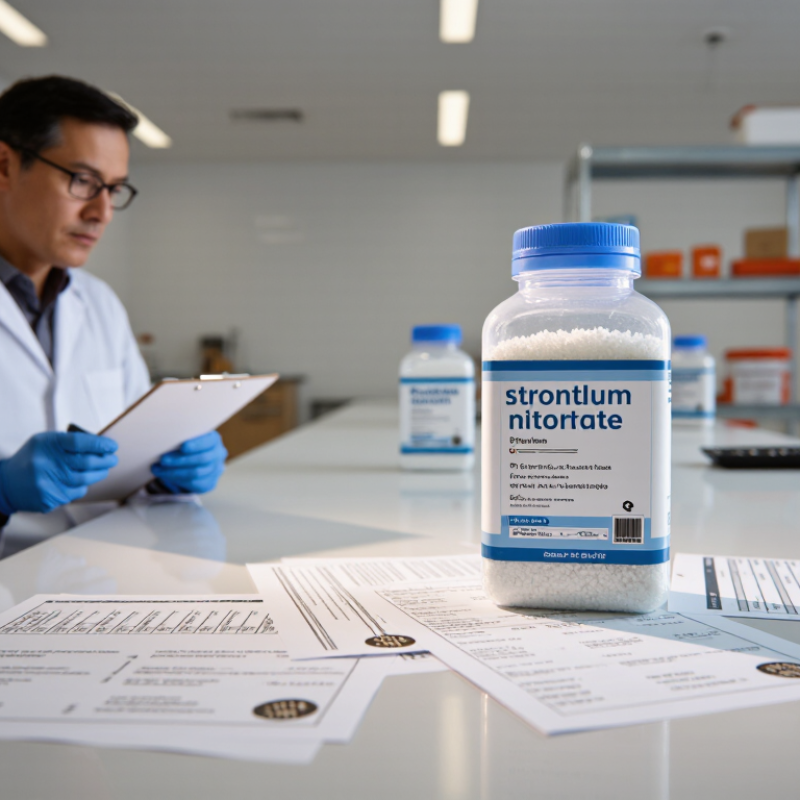
Strontium nitrate is an inorganic salt with the formula Sr(NO3)2. It usually appears as a white, crystalline powder or granule. The compound dissolves in water and acts as an oxidizing material. Its strontium content produces a strong red color when heated, which explains its use in controlled pyrotechnic and signaling applications. These uses require trained handling, suitable storage, and compliance with local regulations.
Its applications extend beyond visible flame effects. Laboratories use strontium nitrate in analytical work and material preparation. Some specialty formulations use it as a strontium source. Certain dental products may also contain strontium compounds for sensitivity management, although the exact ingredient depends on the formulation. Industrial users should check technical data instead of assuming every product has the same performance. Small differences matter.
Buying from a reliable supplier requires more than comparing prices. Request a current certificate of analysis, safety data sheet, stated purity, batch number, and moisture information. Confirm that the packaging protects the material from contamination and humidity. Ask how the supplier manages transport and documentation for oxidizing substances. A polished website is not proof of quality. Specifications can still leave questions. Independent testing may be worthwhile for critical applications. Before ordering, match the material grade with your process, local rules, storage capacity, and trained personnel. Poor planning can create avoidable risk.

Strontium nitrate is an inorganic compound with the formula Sr(NO₃)₂ and CAS number 10042-76-9. Its molar mass is approximately 211.63 g/mol. The chart shows the compound’s theoretical elemental composition by mass, calculated from its chemical formula.
Because it provides strontium and acts as an oxidizing salt, strontium nitrate is commonly used in red fireworks, signal flares, pyrotechnic compositions, and laboratory or industrial formulations. When purchasing, reliable suppliers should provide a current SDS, certificate of analysis, stated purity, batch traceability, suitable packaging, and documentation for applicable transport and regulatory requirements.
Buying strontium nitrate requires more than comparing prices. Confirm that your intended use is lawful in your country and industry. Regulations may differ between laboratory, manufacturing, and educational applications. Ask your compliance officer whether permits, end-use statements, or import documents are required. Check customs rules before placing an international order.
A reliable supplier should provide a current safety data sheet and certificate of analysis. Review purity, moisture content, lot number, test methods, and expiration information. Technical details matter. Confirm the required grade, particle form, packaging size, and storage conditions before payment. Request a sample or independent test when specifications affect your process. A polished certificate is not proof of quality by itself.
Strontium nitrate is an oxidizing chemical. Store it in a cool, dry, well-ventilated area, away from combustible materials and incompatible chemicals. Use suitable gloves, eye protection, and clean handling tools. Never accept damaged packaging. The outer label should show the chemical name, hazard information, batch details, and emergency contact data. Ask how the supplier manages transport and spill documentation. Some vendors answer quickly but provide vague safety records. That is a warning sign. I would rather delay a purchase than approve incomplete paperwork, although this cautious approach can slow urgent projects. Keep invoices, SDS files, test reports, and receiving inspections together for auditability.
When buying strontium nitrate, supplier credentials deserve more than a polished website. Request the company’s legal registration, manufacturing location, quality certificate, and recent audit record. The ISO Survey 2023 reported more than 1.2 million ISO 9001 certificates worldwide, but certification alone does not prove chemical consistency. Check the certificate scope, issuing body, and expiry date. Ask whether the supplier controls production or only resells material. That distinction matters.
Product quality should be verified through a lot-specific certificate of analysis. It should state assay, moisture, chloride, heavy metals, particle size, test methods, and acceptance limits. Strontium nitrate has a molar mass of 211.63 g/mol, making identity checks practical through documented analytical methods. Compare the COA with an independent laboratory result when the purchase is critical. I would not trust a generic PDF. It may be outdated.
Documentation must also follow the UN Globally Harmonized System, 10th revised edition, which defines a 16-section safety data sheet structure. Request the current SDS, technical data sheet, batch traceability, packing details, and transport classification. For international shipments, verify destination-specific registration requirements, including applicable chemical inventories. Keep written records of sample approval, delivery inspection, and complaint handling. Mistakes happen. A supplier that explains them clearly may be more reliable than one promising perfect results.
| Evaluation Dimension | Verified Product or Supplier Information | Evidence to Request | Practical Acceptance Benchmark | Procurement Risk if Missing |
|---|---|---|---|---|
| Chemical identity | Strontium nitrate; chemical formula Sr(NO3)2; CAS Registry Number 10042-76-9 | Product specification, label, SDS, and certificate of analysis (COA) | The chemical name, formula, and CAS number are consistent across all documents | Possibility of receiving a different strontium compound or an incorrectly classified material |
| Molecular-weight reference | Relative molecular mass is approximately 211.63 g/mol for anhydrous Sr(NO3)2 | Technical data sheet or analytical specification | The stated molecular mass matches the anhydrous chemical formula and is not confused with a hydrate | Incorrect stoichiometric calculations, concentration errors, or unsuitable process dosing |
| Purity grade | Purity must be selected according to the intended use; laboratory, industrial, and electronic applications may require different limits | Product specification and lot-specific COA showing the tested assay result | The quoted purity limit is equal to or higher than the buyer's written process requirement | Uncontrolled impurities may affect yield, color, conductivity, or downstream reactions |
| Impurity profile | Relevant limits may include chloride, sulfate, iron, calcium, heavy metals, insoluble matter, and moisture, depending on application | COA with numerical results, test methods, units, and specification limits | Every critical impurity has a defined limit and a reported result for the supplied lot | A high-purity claim cannot be independently assessed or compared between quotations |
| Particle form and appearance | The material may be supplied as crystals or powder; particle size and appearance should be defined for the process | Technical data sheet, sieve analysis, microscopy result, or agreed visual standard | Particle-size range, color, flowability, and caking limits are agreed before purchase | Poor dissolution, dust generation, inconsistent feeding, or batch-to-batch processing changes |
| Oxidizing-property controls | Strontium nitrate is an oxidizing nitrate salt and must be evaluated under the current applicable hazard-classification and transport rules | Current SDS, transport classification, packaging instruction, and emergency information | The classification is current, jurisdiction-specific, and consistent with the shipping documents | Rejected shipments, unsafe storage, fire escalation, or regulatory non-compliance |
| Safety Data Sheet | The SDS should identify hazards, first aid, firefighting, accidental release, handling, storage, exposure controls, disposal, and transport information | Current SDS in the language required at the receiving site | All applicable sections are completed and the revision date is current before shipment | Warehouse personnel may lack accurate handling and emergency instructions |
| Certificate of analysis | A lot-specific COA should identify the batch, test date, test methods, specification limits, and actual results | Signed or electronically controlled COA linked to the shipping lot | The batch number on the COA exactly matches the container label and purchase documents | The received material cannot be traced or objectively released by quality control |
| Testing methodology | Analytical methods should be identified for assay, moisture, particle size, and each critical impurity | Method references, laboratory scope, and representative test data | Methods are suitable for the parameter being measured and are applied consistently between lots | Results may not be reproducible or comparable across suppliers |
| Manufacturing quality system | A documented quality system should control raw materials, production, laboratory testing, nonconformities, and change management | Quality-system certificate, audit summary, or completed supplier questionnaire | Certification scope covers the relevant manufacturing or testing activity and remains valid | Inconsistent quality and limited ability to investigate deviations |
| Traceability | Each container should be linked to a production lot, manufacturing date, and quality release record | Container label, batch record reference, and recall procedure | Two-way traceability exists from shipment to lot and from lot to test and release records | Affected material cannot be isolated efficiently during a complaint or recall |
| Packaging and labeling | Packaging must protect the oxidizing salt from contamination, moisture, physical damage, and incompatible materials | Packaging specification, photographs, label sample, and palletizing details | Containers are sealed, undamaged, clearly labeled, and suitable for the declared transport conditions | Contamination, caking, leakage, incorrect identification, or transport rejection |
| Storage requirements | Store in a cool, dry, well-ventilated area away from combustible materials, reducing agents, acids, and contamination sources | SDS storage section and supplier handling guidance | The receiving site confirms compatible segregation, housekeeping, and moisture control | Higher fire, contamination, caking, and worker-exposure risk |
| Shelf life and retest date | Shelf-life or retest policy should be defined because storage conditions can affect moisture, caking, and suitability | Manufacturing date, retest date, storage conditions, and requalification procedure | The remaining usable period meets the buyer's minimum requirement at delivery | Shortened usable life or unexpected quality failures during storage |
| Regulatory and import readiness | The buyer and supplier must confirm applicable chemical registration, workplace, customs, and transport requirements for the destination country | Regulatory statement, customs data, SDS, invoice description, and transport documents | All documents use consistent identity, classification, quantity, and packaging information | Customs delays, returned cargo, fines, or inability to legally receive the material |
| Pre-shipment sample and approval | A representative sample can be evaluated before committing to the full order when process sensitivity is high | Sample label, sample COA, retention sample policy, and internal test results | The sample passes the buyer's identity, purity, impurity, moisture, and physical-form checks | A full shipment may fail after delivery, creating disposal and replacement costs |
| Complaint and corrective-action process | The supplier should have a defined process for investigating nonconforming material and implementing corrective action | Written complaint procedure, response-time commitment, and sample corrective-action record | Nonconformities are documented, investigated, and resolved with traceable actions | Repeated failures, unclear responsibility, and prolonged production interruption |
Note: Acceptance limits should be finalized in the purchase specification according to the intended application, destination-country regulations, and the buyer's internal quality requirements.
When buying strontium nitrate, compare complete quotations rather than unit prices alone. Ask for purity, assay method, batch size, and certificate of analysis. A low price may hide testing fees, minimum order quantities, or costly export paperwork. Request a delivered-cost estimate that includes handling, insurance, duties, and local taxes. Prices should be compared by usable kilogram, not simply by container price.
Packaging deserves equal attention. Confirm the net weight, inner liner, seal quality, and container material. The package should arrive clean, intact, and clearly labeled with batch details and hazard information. Smaller quantities may reduce waste, while larger packs can lower the unit cost. That calculation is easy to overlook. I have found that a slightly higher quote sometimes offers better traceability and fewer damaged shipments.
Shipping conditions can affect product quality. Ask whether the supplier uses trained carriers and provides the required transport documents. Check delivery schedules, temperature exposure, and procedures for delayed or rejected packages. Before ordering, review the safety data sheet and local chemical requirements. Store the material in a cool, dry, well-ventilated area, away from heat, moisture, combustible materials, and incompatible chemicals. Keep the original label visible and limit access to trained personnel. Storage space matters. A crowded cabinet can undermine an otherwise careful purchase. Reliable suppliers should answer these questions clearly, provide consistent documents, and explain how they protect the material from dispatch to receipt.
Buying strontium nitrate responsibly begins with a verifiable order, not a quick price comparison. I check supplier registration, technical contacts, and documented experience with regulated laboratory chemicals. The supplier should provide a current SDS, certificate of analysis, lot number, purity, packaging details, and delivery conditions. I compare these details with our intended use and local requirements. Small mismatches matter. A missing lot number can make later tracing difficult.
Before payment, I confirm the exact chemical name, requested quantity, container size, and receiving address. Written confirmation prevents assumptions between purchasing and receiving teams. I also ask how damaged packages are reported and which carrier procedures apply. Only trained staff should receive the material. They inspect the outer box, seals, labels, and paperwork in a designated area. If anything looks unusual, they isolate the package and contact the supplier and safety officer.
Safe handling records should be practical, dated, and easy to audit. I record the purchase order, lot number, arrival condition, storage location, user, training status, and disposal route. The SDS stays accessible near the inventory record, not buried in an email folder. Strontium nitrate should be stored according to its SDS, away from incompatible materials and ignition sources. We use clean, labeled equipment and appropriate protective controls. I once treated a complete-looking file as sufficient; it was not. The training date was missing. That gap changed our process: every review now includes signatures, corrective actions, and a follow-up date. Good records protect people and clarify responsibility.
2025 Bio-Botanica, a division of Bio Answer Holdings Inc. All Rights Reserved.