
Choosing Clay Litter for an international market involves more than comparing prices or reading a product label. Buyers need to understand how the material performs in everyday use and whether its quality stays consistent between shipments. A sample may look clean and feel dry, yet produce noticeable dust when poured. Clumping strength, particle size, moisture control, and odor management all deserve practical checks. Small details matter.
This guide presents ten buying tips to help global buyers assess products and suppliers with care. It covers clay composition, product specifications, packaging durability, sample evaluation, production capacity, and clear communication. Ask for current specifications and test samples under realistic conditions, such as scooping a tray after regular use. Compare results across batches when possible; one good sample does not guarantee repeatable quality. That takes patience.
Shipping costs and packaging choices can also affect the final landed price, so compare complete quotations rather than unit prices alone. Confirm that product descriptions, weights, and handling details are clear before placing an order. Do not rely on broad claims without supporting information. Some factors are difficult to judge from a brochure, and even a careful checklist cannot remove every uncertainty. That is worth admitting. By asking focused questions and documenting evaluations, buyers can make more informed decisions and build dependable supplier relationships.
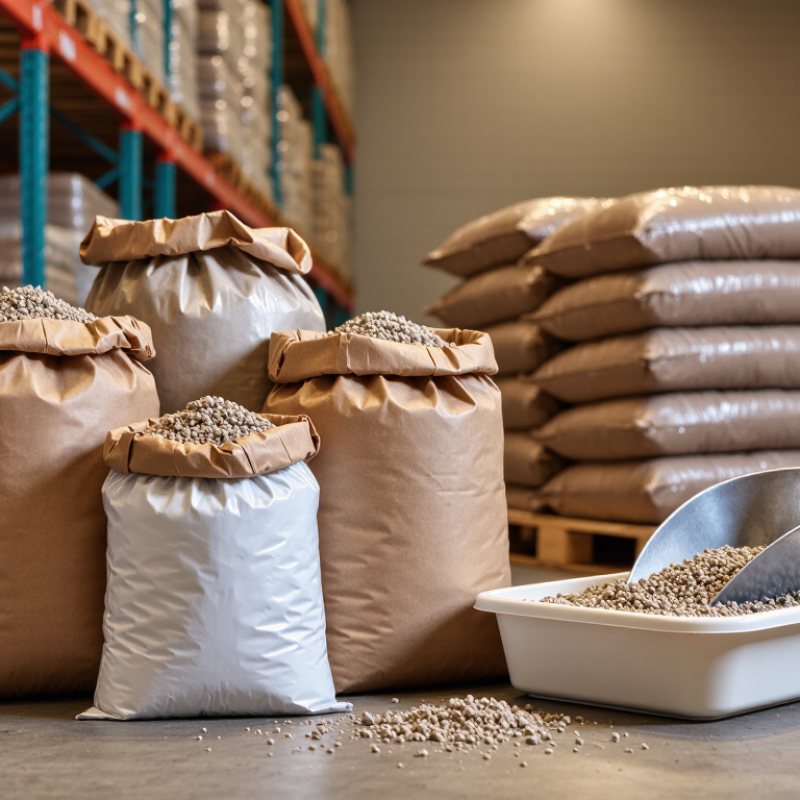
Before comparing suppliers, identify the clay and how it forms clumps. Sodium bentonite swells when wet, binding particles into scoopable clumps. Calcium bentonite generally swells less, while some non-clumping clays absorb moisture without forming firm masses. Product names alone can be vague. Ask for the clay type, any blend details, and a technical data sheet.
Tip: Test samples under the same conditions. Use equal litter depth, the same liquid amount, and a fixed waiting time. Then scoop each sample and note clump strength, breakage, dust, and sticking to the tray. Small differences matter. A neat sample can still behave differently after transport or storage.
Supplier comparisons are more useful when the test method stays consistent. Check moisture content and particle size, too; both can affect handling and clumping. Ask how specifications are measured, and request results for the actual production grade. I still find it easy to focus on price before checking these details. That can mean comparing products that do not perform alike. Keep your observations in writing, including any weak clumps or dusty pours. A single test is not perfect, but it gives buyers a clearer basis for questions and follow-up samples.

Compare absorption only when suppliers use the same test conditions. Ask for liquid type, sample mass, contact time, and retained-liquid calculation. A result such as “absorbs quickly” is hard to verify without these details. Request replicate tests and the range, not just the best result. Small shifts matter. A coarse granule may absorb well yet leave wet patches between pieces.
Granule size reports should show D10, D50, and D90, not only an average. ISO 13320:2020 describes laser diffraction methods for particle-size analysis, which can help buyers compare supplier results. For dust, request both total and respirable particulate measurements. NIOSH Manual of Analytical Methods 0500 and 0600 describe gravimetric sampling for these fractions; they are measurement methods, not proof that a product is dust-free or safe in every setting. Compare results from the same sampling setup and report the test conditions. I still find one weakness in supplier sheets: some omit sample handling, which can change the dust result. Ask for the raw report, instrument details, and test date before treating a single number as decisive.
Use the same test conditions and request results for the specific production lot being quoted. There is no single universal pass/fail limit for every clay litter type; agree on product-specific requirements before comparing suppliers.
| Buying tip | Data to request | Unit or test detail | How to compare |
|---|---|---|---|
| 1. Compare liquid absorption | Water absorbed by a weighed litter sample | g water per g litter; request the liquid amount, contact time, drainage procedure, and replicate results | Compare only results obtained with the same procedure. Higher absorption alone does not establish better odor control or clumping. |
| 2. Check granule-size distribution | Percentage passing or retained on each sieve | Mass % by sieve opening in mm; ask for the sieve series and test method | Look at the full distribution, not just a stated “average” size. Compare the proportion of fines, target granules, and oversize material. |
| 3. Measure dust consistently | Dust or fine-particle content | Mass % below a stated sieve size, or a named dust-test result; request the sample handling and test method | Do not compare “low dust” claims without a defined method and cutoff. Check dust both before and after realistic transport handling if possible. |
| 4. Review moisture content | Moisture in the finished product | Mass %; request the drying or moisture-analysis method and lot sampling details | Compare samples tested by the same method. Moisture can affect weight, flow, storage stability, and the interpretation of absorption results. |
| 5. Compare bulk density for freight planning | Mass of loose litter per measured volume | kg/m³ or g/L; request container size, filling procedure, and whether the sample was settled | Use density with package dimensions and net weight to estimate pallet and container utilization; do not treat it as a direct measure of absorbency. |
| 6. Test clump formation and strength | Clump integrity after liquid contact and a defined setting time | Request the liquid dose, litter depth, setting time, handling or strength procedure, and number of replicates | Compare side by side under identical conditions. Ask whether the reported result measures clump breakage, force, or another defined outcome. |
| 7. Check fines and oversize after handling | Change in sieve distribution after a stated handling test | Mass % by sieve before and after handling; request the handling procedure | A before-and-after comparison helps identify granules that break during packing or shipping. Use the same handling sequence for all samples. |
| 8. Verify odor-control claims | Defined odor-test results, if available | Request the test protocol, test material, duration, evaluation method, and whether results are instrumental or sensory | Odor performance depends on test conditions. Treat an unsupported claim as unverified and compare samples in a controlled evaluation. |
| 9. Request safety and mineral-composition documents | Current safety data sheet and relevant laboratory reports | Document date, test scope, sample identity, and applicable destination-market requirements | Confirm that documents refer to the offered product and intended market. Avoid assuming that a general document covers every formulation or shipment. |
| 10. Confirm lot consistency and packaging data | Recent lot-to-lot results, net weight, package dimensions, and packaging specification | Request dated reports for multiple lots, declared net weight, bag dimensions, and pallet configuration | Compare variation as well as the latest result. Check that the sample, specification, and shipment documentation identify the same product and lot. |
Buyer’s comparison record: product type ______; lot number ______; sample date ______; test method ______; agreed acceptance limits ______. Ask suppliers to provide actual, dated test results rather than estimated or illustrative figures.
10 Clay Litter Buying Tips for Global Buyers
For clay litter buyers, silica claims need careful checking. OSHA’s 50 µg/m³ limit applies to respirable crystalline silica as an eight-hour time-weighted average. It is an occupational exposure limit, not a product certification or a guarantee that a shipment is safe to handle. Ask suppliers for recent test reports that identify the silica type, sampling method, and tested product batch. “Low dust” on a label is not enough.
Tip: Request representative dust data and a safety data sheet. Confirm whether results cover respirable crystalline silica, rather than total dust alone. In a warehouse, look for visible dust near bag-opening stations and conveyors. Enclosed transfer points, local exhaust ventilation, and careful cleanup can reduce airborne dust. Avoid dry sweeping, which may put settled particles back into the air. Use exposure monitoring where workers may generate dust, and have a qualified safety professional interpret results.
No single test predicts every handling condition. Bag damage, humidity, pouring height, and ventilation can change dust levels. That part is easy to overlook. Buyers should ask how samples were collected and whether the test reflects normal unloading, not just a controlled laboratory pour. If results approach the limit, review controls before relying on respirators or assuming the product needs no further assessment.
How to read this chart: OSHA sets an action level of 25 µg/m³ and a permissible exposure limit (PEL) of 50 µg/m³ for respirable crystalline silica, measured as an 8-hour time-weighted average. These are occupational air-exposure benchmarks—not silica-content limits for clay litter. Buyers can ask suppliers about dust-control measures and relevant workplace exposure monitoring.
Source: OSHA Respirable Crystalline Silica Standard, 29 CFR 1910.1053. Values shown are regulatory benchmarks, not product test results.
For global buyers, a 20-ft container offers about 33 m³ of nominal space, not a guaranteed usable load. Check the carrier’s payload limit and the actual packing plan before confirming quantities. Clay litter is dense, so weight may become restrictive before the container looks full. Ask the supplier to share a loading diagram showing bag sizes, pallet use, and remaining space.
Verify each production batch with representative samples, not just one bag from the top of a stack. Compare granule size, moisture, dust, and clumping against an agreed specification. Keep a sealed reference sample with the batch number and inspection date. Small differences matter. A tidy sample can hide variation between bags, so inspect several units and record any mismatch before shipment.
Packaging needs equal attention. Check seals, stitching, print legibility, and resistance to handling; press the bags gently to spot weak seams. Request loading photos that show dry flooring, stable stacks, and protection from sharp edges. Bags may shift during transit, even when the container appears well packed. Allow room for safe handling, and confirm gross weight against shipping documents. The cubic estimate is useful, but it is not a substitute for weighing the load.
A low quoted price can hide substantial costs. Before ordering clay litter, request the current Safety Data Sheet (SDS) and confirm it matches the product’s composition. Check the revision date, handling guidance, dust information, and transport details. An SDS is useful, but it is not a substitute for destination-specific checks. Keep the product name and composition consistent across the SDS, invoice, and packing list.
Destination-country rules may affect labeling, packaging, product documentation, or import procedures. Confirm requirements with the relevant authority or a qualified local importer before production. Ask whether labels need a local language, specific hazard statements, or particular disposal guidance. Requirements can change. Do not rely only on a supplier’s past shipments; your product, packaging, or port may differ. A missing document can cause delays, even when the goods themselves are acceptable.
Calculate total landed cost, not just the price per tonne. Include freight, insurance, duties, taxes, port handling, customs clearance, inland delivery, and possible storage or inspection fees. Compare quotes using the same shipment size and delivery point. Clay is heavy, so pallet weight, bag dimensions, and container loading can materially affect freight costs. Request a written estimate with each charge listed. It is easy to overlook small fees, and estimates are not guarantees; leave room in the budget for changes. Before paying a deposit, check who handles each step and what happens if documents need correction.
2025 Bio-Botanica, a division of Bio Answer Holdings Inc. All Rights Reserved.