Sourcing Herb Breadcrumbs globally in 2026 requires more than comparing prices between suppliers. The product combines bread, herbs, oils, salt, and sometimes allergens. Each ingredient creates a separate supply, quality, and traceability question. A low-cost quotation may hide higher freight exposure, weaker documentation, or inconsistent particle size.
Industry data supports a cautious approach. The FAO estimates that food systems generate about 31% of global greenhouse-gas emissions, making transport distance, packaging, and production efficiency increasingly relevant procurement factors (FAO, 2021). The World Bank’s Logistics Performance Index 2023 also shows substantial differences in customs efficiency, infrastructure, and shipment reliability across markets. These differences can affect delivery schedules for a seemingly simple ingredient. The OECD-FAO Agricultural Outlook 2024–2033 further highlights continuing volatility in agricultural inputs, trade flows, and climate-sensitive production.
Quality must remain measurable. Buyers should request ingredient specifications, allergen declarations, microbiological results, pesticide-residue controls, and certificates from recognized food-safety schemes. HACCP-based systems, ISO 22000, BRCGS, and FSSC 22000 can strengthen supplier evaluation, but certificates alone do not prove daily performance. Ask for recent batch records. Inspect the crumbs.
A practical 2026 sourcing plan should map herb origin, bread production, milling, storage, and final export documentation. It should also compare landed cost, not only the factory price. Unexpected moisture, damaged cartons, or port delays can change the decision quickly. My caution is simple: global sourcing models often look precise in spreadsheets, yet agricultural supply chains remain imperfect. Small pilot orders, independent testing, and dual sourcing may offer stronger protection than an attractive annual contract.
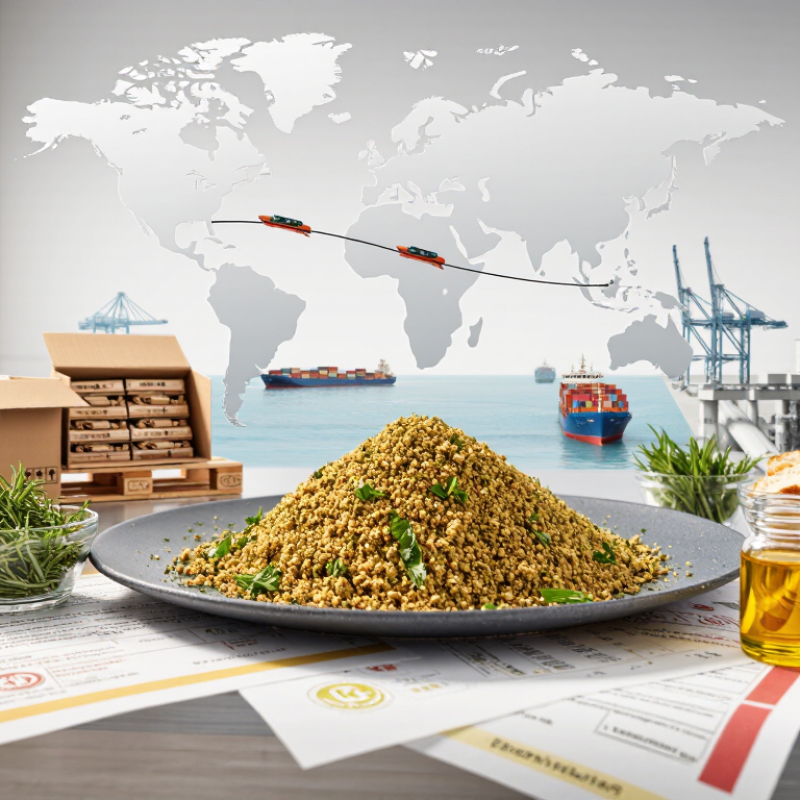
Herb breadcrumbs are dried bread particles blended with culinary herbs and seasoning. They add crispness, aroma, color, and light savory flavor to coated foods. Particle size matters. Fine crumbs create an even crust, while coarse crumbs produce a rougher, louder bite. Some suppliers also offer toasted or panko-style formats.
Key features include low moisture, consistent granulation, stable herb distribution, and clean-label ingredients. Moisture control is critical because soft crumbs can encourage clumping and spoilage. The U.S. Food and Drug Administration identifies 4.6 as the critical pH boundary for many acidified foods, but breadcrumbs are usually low-moisture products. Water activity testing remains more useful here. It should be requested, not assumed. Herb sourcing also needs traceability, pesticide records, allergen statements, and microbial certificates.
Global buyers should compare wheat, corn, and gluten-free bases before requesting quotations. The USDA FoodData Central database shows that breadcrumb nutrition varies by recipe, especially for sodium, fat, and fiber. This makes specification sheets essential. A 2024 Grand View Research estimate placed the global bread crumbs market at more than USD 1 billion, with continued growth expected through the decade. Meanwhile, the FAO reports that 13.2% of food is lost between harvest and retail. Better packaging, sealed liners, and realistic shelf-life testing can reduce avoidable waste. I would not trust a colorful sample alone. Aroma can fade during transit. A controlled pilot shipment may reveal the truth.
| Data Dimension | Definition or Sourcing Requirement | Typical Industry Information | 2026 Buyer Checkpoint |
|---|---|---|---|
| Product Definition | Herb breadcrumbs are dried, milled bread particles blended with culinary herbs and used as a coating, topping, stuffing ingredient, or textural component. | The formula generally contains bread crumbs, dried herbs, salt, spices, and may include permitted processing aids or anti-caking ingredients. | Confirm the legal product name, intended food application, ingredient statement, and allergen declaration before requesting quotations. |
| Bread Base | The bread base determines color, flavor, particle structure, crispness, and allergen profile. | Common bases include white bread, wheat bread, whole-wheat bread, and gluten-free bread formulations. | Request confirmation of wheat, gluten, milk, egg, soy, sesame, and other allergens relevant to the destination market. |
| Herb Composition | Herbs provide aroma, color, and flavor intensity and should be specified by common name and, where appropriate, botanical name. | Frequently used dried herbs include parsley, oregano, basil, rosemary, thyme, marjoram, and sage. | Define the percentage of each herb, cut size, color expectation, flavor profile, and acceptable natural variation. |
| Particle Size | Particle size affects coating coverage, mouthfeel, visual appearance, oil uptake, and cooking performance. | Commercial specifications commonly distinguish fine, medium, and coarse crumbs; the exact sieve range is agreed between buyer and supplier. | Include a sieve-analysis requirement and define the maximum percentage of fines, oversize particles, and foreign material. |
| Moisture and Water Activity | Low moisture and controlled water activity help preserve crispness and reduce the risk of microbial growth during storage. | A practical purchasing specification often sets moisture around 5–10%, subject to the product formula and validated shelf-life study. | Require a certificate of analysis for moisture and, where relevant, water activity, with test methods stated. |
| Microbiological Safety | Finished-product safety depends on hygienic processing, validated controls, dry storage, and testing for relevant microorganisms. | Typical specifications address total aerobic count, yeast and mold, coliforms or Enterobacteriaceae, and absence or limits for pathogens such as Salmonella. | Obtain the microbiological specification, recent test results, environmental-monitoring summary, and food-safety plan. |
| Herb Authenticity | Authenticity verifies that declared herbs are present at the stated quality and are not replaced or diluted with undeclared plant material. | Risk-based controls may include supplier approval, identity testing, microscopy, chromatographic analysis, or DNA-based methods. | Use a documented herb-adulteration risk assessment and require traceability to the herb-processing lot. |
| Color and Flavor | Color should be characteristic of the bread and herbs, while flavor should be clean, balanced, and free from rancid, burnt, musty, or chemical notes. | Sensory quality can vary with herb origin, drying method, storage duration, bread formulation, and exposure to light or oxygen. | Approve a sealed reference sample and define sensory acceptance criteria before commercial production. |
| Ingredient and Allergen Compliance | The product must comply with the food-labeling and allergen rules of the importing and selling markets. | Bread-based crumbs commonly require attention to cereals containing gluten; additional allergens depend on the recipe and shared equipment. | Request the full formula, allergen matrix, cross-contact controls, GMO statement where required, and additive declarations. |
| Packaging | Packaging should protect the dry product from moisture, oxygen, light, pests, and physical damage during international transport. | Common commercial formats include sealed food-grade bags, multiwall sacks, lined cartons, and bulk containers. | Specify pack size, barrier properties, pallet pattern, net-weight tolerance, packaging-material compliance, and recycling information. |
| Shelf Life and Storage | Shelf life is the period during which the product retains safety, flavor, texture, and specification compliance under stated conditions. | Dry breadcrumbs are generally stored in a cool, dry, clean area away from direct sunlight, strong odors, pests, and condensation. | Validate the shelf life using real-time or accelerated data and define minimum remaining shelf life at shipment and arrival. |
| Global Sourcing Regions | Sourcing should consider the availability of bread inputs, dried herbs, food-processing capacity, export infrastructure, and regulatory compatibility. | Potential supply regions include Europe, North America, Latin America, North Africa, the Middle East, and Asia-Pacific, with capabilities varying by country and product type. | Evaluate origin stability, crop-season exposure, port access, climate risk, customs requirements, and alternative routes. |
| Supplier Qualification | Qualification confirms that a supplier can consistently meet product, safety, legal, capacity, and service requirements. | A robust review includes a questionnaire, document assessment, sample approval, risk classification, and an on-site or remote audit where appropriate. | Prioritize a certified food-safety management system, documented traceability, recall capability, change-control procedures, and business-continuity planning. |
| Certifications and Documentation | Documentation demonstrates that the product and facility meet applicable food-safety, quality, ethical, and market-access requirements. | Documents may include a certificate of analysis, product specification, allergen statement, origin statement, audit report, and organic or religious-certification documents where applicable. | Match every certificate and declaration to the exact manufacturing site, product code, production date, and destination-market requirement. |
| Traceability | Traceability links finished herb breadcrumbs to bread ingredients, herbs, seasonings, packaging materials, processing records, and shipment details. | Each lot should have a unique identification code and records should support one-step-back and one-step-forward tracing. | Test the traceability system through a documented mock recall and establish retention periods for quality records. |
| Commercial and Logistics Terms | The delivered cost includes product price, packaging, inland transport, freight, insurance, duties, testing, storage, and potential customs delays. | Dry products may be shipped by sea, road, rail, or air depending on urgency, order size, destination, and shelf-life requirements. | Compare total landed cost, minimum order quantity, production lead time, payment terms, Incoterms, shipment temperature requirements, and contingency stock. |
Note: The numerical ranges and requirements shown are practical procurement reference points. Final limits should be agreed with the supplier, validated against the intended application, and checked against the regulations of the destination market.