
Calcium Carbonate Stone appears in many forms, from pale limestone blocks to polished marble slabs and finely finished architectural surfaces. For buyers, the name alone does not tell the whole story. Stone from different quarries can vary in color, veining, density, finish, and performance. A warm ivory sample may look uniform under showroom lights, yet show subtle fossil marks in direct sunlight. Details matter.
This guide introduces ten suppliers operating across global markets and explains what buyers may want to check before making contact. Selection considerations include quarry or sourcing information, product range, available finishes, sample access, stated specifications, and experience with export orders. Clear documentation helps, but it does not replace reviewing a physical sample or confirming the requirements of a particular project. No supplier is right for every use. A countertop, façade, and garden paving each face different conditions, so suitability should be assessed individually.
Supplier information can also change. Product availability, lead times, and shipping arrangements may depend on location and order size. Treat this list as a starting point, not a guarantee of quality or endorsement. That distinction is important. Comparing written specifications with samples, asking direct questions, and checking current references can reveal gaps that a polished catalog may not show. Some details remain difficult to verify from public information alone; careful follow-up is part of a sound purchasing decision.
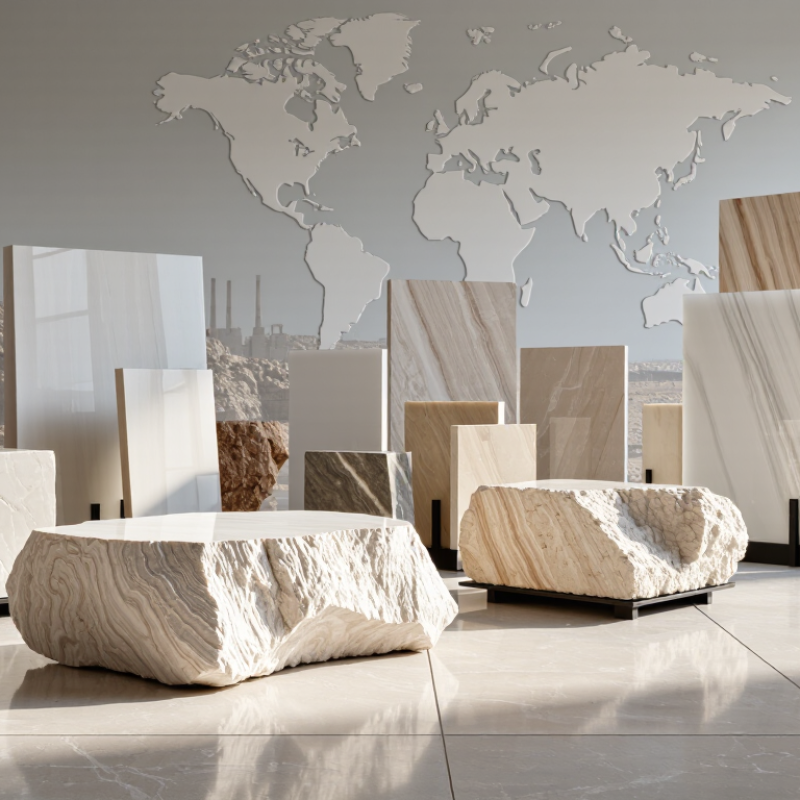
Calcium carbonate stone is a broad geological family, not a single uniform material. Its main mineral is calcite, though some rocks also contain aragonite. Limestone forms from marine sediments and shell fragments; marble develops when limestone is changed by heat and pressure. Chalk is a softer, fine-grained variety. Travertine forms as mineral-rich water deposits carbonate, often leaving visible pores. Details matter.
Color and performance depend on more than the carbonate itself. Small amounts of clay, silica, or iron minerals can create veining, gray tones, or warm rust shades. Marble may take a smooth polish, while porous travertine often shows pits and natural openings. A quick visual check can be misleading. Ask for consistent samples and technical details, since stones from the same region may still vary.
These differences shape practical uses. Dense limestone and marble are common in flooring, wall cladding, and carved features; travertine suits facades and interior surfaces when its pores are properly filled. Softer chalk is less suitable for high-wear floors. Carbonate stone can react with acidic cleaners, so mild, stone-compatible products are safer. It also scratches more easily than many silicate stones. That trade-off is real: a beautiful finish may need careful maintenance, and no stone selection should rely on appearance alone.
| Source Market | Common Calcium Carbonate Stone Types | Typical Composition | Common Uses |
|---|---|---|---|
| China | Limestone, marble, and calcite stone | Usually calcite-rich; dolomite may occur in some deposits. Composition and purity vary by quarry. | Building stone, flooring, wall cladding, cement, and ground calcium carbonate products. |
| India | Marble and limestone | Marble is recrystallized carbonate rock, commonly calcite-rich; some varieties contain dolomite or other minerals. | Architectural stone, tiles, monuments, cement, and lime production. |
| United States | Limestone, marble, and chalk | Limestone and chalk are chiefly calcite; dolomitic limestone contains both calcite and dolomite. | Aggregate, cement, lime, construction stone, agricultural applications, and industrial mineral products. |
| Turkey | Marble, limestone, and travertine | Predominantly carbonate minerals, especially calcite; travertine forms through calcium-carbonate precipitation from water. | Tiles, slabs, façades, paving, interior finishes, and dimension stone. |
| Italy | Marble and limestone | Marble is mainly recrystallized calcite or, in some varieties, dolomite; mineral content differs among deposits. | Sculpture, flooring, countertops, façades, restoration, and architectural detailing. |
| Spain | Marble, limestone, and ornamental carbonate stone | Typically calcite-rich, with dolomite and accessory minerals present in some stone varieties. | Construction, flooring, cladding, paving, decorative stone, and lime or cement manufacture. |
| Egypt | Limestone and marble | Limestone is commonly calcite-dominant; local stone characteristics vary in texture, color, and accessory minerals. | Building and restoration stone, cladding, flooring, cement, and lime. |
| Greece | Marble and limestone | Marble is generally calcite- or dolomite-based; color and veining reflect mineral impurities and geological conditions. | Sculpture, monuments, flooring, façades, and decorative architectural stone. |
| Vietnam | Limestone and marble | Carbonate deposits are commonly calcite-rich, though mineral composition and suitability differ between geological formations. | Dimension stone, tiles, construction materials, cement, and lime. |
| Brazil | Marble and limestone | Marble commonly contains recrystallized calcite or dolomite; the exact mineral mix depends on the deposit. | Slabs, flooring, countertops, cladding, construction stone, and cement raw material. |
Note: These are representative global sourcing markets, not a ranked list of companies. Calcium carbonate content and stone quality vary by deposit and should be confirmed through supplier specifications and laboratory testing.

Identifying the world’s leading calcium carbonate stone suppliers takes more than comparing quarry size or export volume. The USGS Mineral Commodity Summaries 2024 estimated U.S. crushed-stone production at about 1.5 billion tons in 2023; limestone and dolomite formed the largest share. This indicates a substantial raw-material base, but it does not prove a supplier can deliver consistent industrial-grade stone. Buyers should compare geological reserves, processing capacity, shipment history, and access to ports or rail.
Technical evidence matters. Request recent certificates of analysis for calcium carbonate content, magnesium, iron, moisture, and particle-size distribution. Check whether results come from a qualified laboratory and match the specific shipment, not just a general product sheet. Compare samples under the same test method; brightness and purity can vary between seams and batches. That matters. Also assess packaging, lead time, minimum order quantities, and delivered cost. A low quotation can hide costly freight or inconsistent specifications. A ranking can still miss local service quality, and supplier data is not always independently verified.
Tips: Ask for a recent batch report and a representative sample. Confirm the shipment’s origin and loading port. Keep a small reserve for retesting; even careful comparisons have gaps.
Calcium carbonate suppliers are spread across regions with different deposits, processing capacity, and transport costs. The map is uneven. Asia-Pacific has a broad base of quarrying and powder-processing operations, serving construction, plastics, paper, and coatings manufacturers. China and India are major production centers, while Southeast Asian suppliers often serve nearby industrial markets. Output and product consistency can vary between facilities, even within one country.
European producers commonly compete through refined grades, technical documentation, and established delivery networks. In North America, suppliers benefit from access to large end-user markets, though freight distance can shape prices between inland and coastal customers. Turkey and parts of the Middle East connect mineral resources with regional export routes. These patterns are useful, but they are not fixed; energy prices, port congestion, and local demand can quickly change sourcing economics.
A regional comparison should go beyond quoted price. Buyers often check calcium carbonate content, particle-size distribution, brightness, moisture, and packaging suitability against a specific process. A fine powder for paper coating may not match the needs of a construction blend. Samples and recent quality records help reveal differences that brochures may miss. Even then, supplier comparisons are imperfect: specifications can use different test methods, and delivery estimates rarely capture every disruption.
Worldwide calcium carbonate stone suppliers differ in quarry access, processing depth, and product consistency. An integrated quarry operator controls extraction and cutting, while a regional block producer focuses on dependable raw stone. White-stone specialists select pale material for interiors. High-purity limestone suppliers emphasize measured mineral composition. Decorative marble exporters grade slabs by color and visible veining. Each profile serves a different project.
Some suppliers add more processing. Slab processors offer polished or honed finishes; dimension-stone cutters prepare tiles, steps, and custom pieces. Powder-grade processors handle limestone for industrial applications, so buyers should confirm that the product is stone, not simply a processed mineral. Offcut-focused distributors may provide smaller pieces at practical prices. Local stockholders can shorten delivery times and make inspection easier. Small details matter.
A useful supplier profile should explain quarry origin, available grades, finishing options, and quality checks. Ask for current photographs, sample pieces, and written size tolerances. Check for hairline cracks, uneven thickness, and color variation under natural light. Claims can sound polished. Samples are more revealing. Not every supplier publishes comparable test data, and that gap deserves scrutiny. A careful comparison weighs consistency and communication alongside price, since a low quotation may exclude crating, finishing, or replacement terms.
Calcium carbonate mineral-form density benchmarks
This chart shows representative mineral densities, not supplier rankings or company data. Calcite, aragonite, and vaterite are naturally occurring forms of calcium carbonate; reported values can vary slightly between references and specimens.
A capable calcium carbonate stone supplier should control more than extraction. Consistent quarry selection, sorting, crushing, and milling help maintain predictable chemistry and particle size. Buyers can request lot-specific data for calcium carbonate content, whiteness, moisture, and particle-size distribution. A sample should also match the material shipped, not just a preferred production batch. Small detail, big difference.
Grades vary by processing and end use. Coarse stone may suit construction blends, while finely ground grades are used in coatings, paper, plastics, and sealants. Some applications prioritize brightness; others need controlled particle shape, low moisture, or steady flow through production equipment. A datasheet matters, but it cannot show every handling issue. Ask about testing methods, packaging options, shipment consistency, and how the supplier manages changes between deposits. Independent laboratory checks can help when specifications are critical. No supplier is perfect; a slightly awkward question about off-spec material may reveal more than a polished sales presentation.
2025 Bio-Botanica, a division of Bio Answer Holdings Inc. All Rights Reserved.